Seth France, b. 1972
Habent sua fata libelli, 2016
Acrylic and spray paint on canvas
130 x 90 cm
Copyright The Artist


In Habent sua fata libelli (“Books have their own destiny”), Seth constructs an image that is both disarmingly simple and profoundly evocative: a child sleeps beneath an oversized book that...
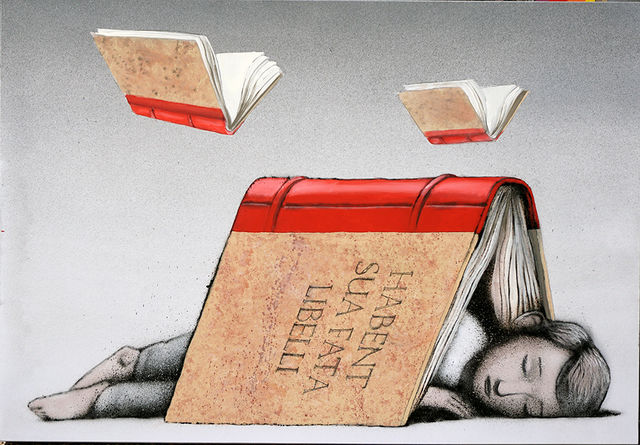
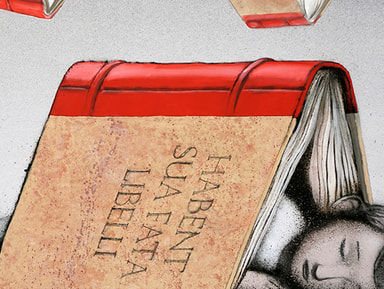
In Habent sua fata libelli (“Books have their own destiny”), Seth constructs an image that is both disarmingly simple and profoundly evocative: a child sleeps beneath an oversized book that becomes at once a house, a shelter, a roof. Other books float weightlessly in the surrounding space, like silent presences suspended between dream and reality.
The Latin title suggests that every book carries its own fate — yet it also implies that within each book lies a possible destiny for its reader. Here, the volume is not merely a cultural object; it is protective architecture, a landscape of imagination. The child does not read the book — he inhabits it.
In this way, Seth transforms culture into an inner terrain. The serene expression on the child’s face conveys trust, surrender, and dreamlike immersion.
The book thus becomes a metaphor for the shaping of the self: what we read — or what we are told — gradually constructs our inner home.
The Latin title suggests that every book carries its own fate — yet it also implies that within each book lies a possible destiny for its reader. Here, the volume is not merely a cultural object; it is protective architecture, a landscape of imagination. The child does not read the book — he inhabits it.
In this way, Seth transforms culture into an inner terrain. The serene expression on the child’s face conveys trust, surrender, and dreamlike immersion.
The book thus becomes a metaphor for the shaping of the self: what we read — or what we are told — gradually constructs our inner home.
1
of
17


