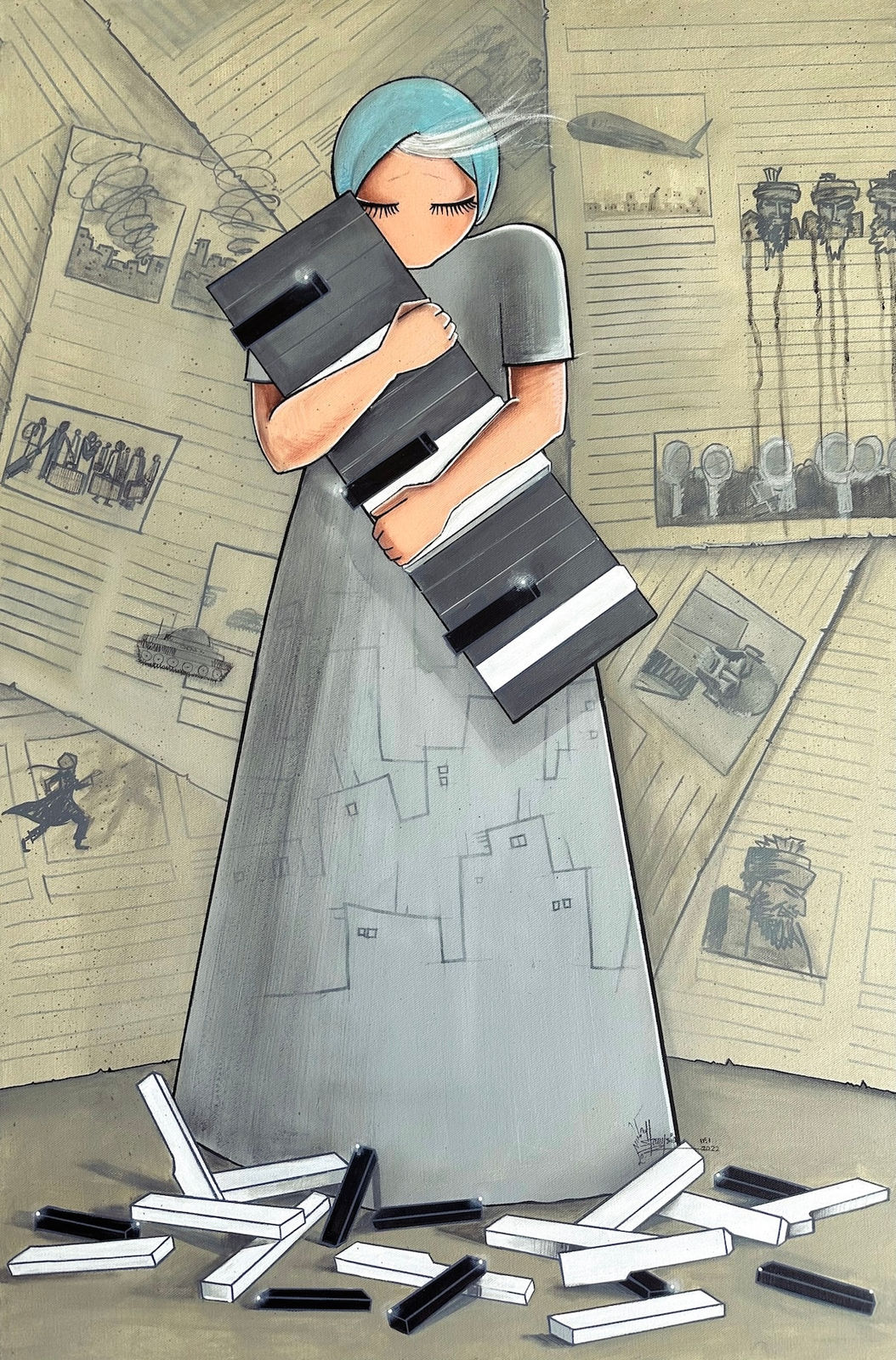
Shamsia Hassani Afghanistan, 1988
24 x 36 in
Further images


"In the poignant work Kabul Has Fallen, Shamsia Hassani gives voice to the silent grief of an entire city through the figure of a woman, portrayed as she clutches a piano shattered by war. She embraces it with the tenderness and despair one might show a loved one — a child, a brother, a lost dream. That piano, once a vessel of harmony, becomes here a symbol of Kabul itself: its voices, its culture, its people, all silenced.
At her feet, the instrument’s keys lie scattered across the ground, fallen like the victims of conflict — black and white fragments of a broken humanity. The woman’s dress, blending almost seamlessly with the city’s architecture, is adorned with stylised silhouettes of buildings: the skyline of Kabul etched into fabric, as if she herself were the city — living, wounded, and enduring.
In the background, sheets of newspaper act as silent witnesses to the tragedy — chronicles of pain, of collapse, of history folding upon itself like crumpled paper. With her signature visual strength, Hassani weaves together symbols and silence, turning collective sorrow into a powerful, lyrical, and universal image."
"Nella struggente opera Kabul Has Fallen, Shamsia Hassani dà voce al dolore muto di un’intera città attraverso la figura di una donna, ritratta mentre stringe a sé un pianoforte spezzato dalla guerra. Lo abbraccia con la tenerezza e la disperazione con cui si stringerebbe un corpo amato, un figlio, un fratello, un sogno perduto. Quel pianoforte, strumento di armonia, è qui simbolo della città di Kabul: delle sue voci, della sua cultura, dei suoi abitanti ridotti al silenzio.
Ai suoi piedi, i tasti dello strumento giacciono sparsi, caduti a terra come le vittime del conflitto — frammenti bianchi e neri di un’umanità infranta. Il vestito della donna, che si fonde quasi con l’architettura stessa, è decorato con sagome stilizzate di edifici: sono i palazzi di Kabul, incisi sulla stoffa come memorie indelebili, come se lei stessa fosse la città, viva e vulnerabile.
Sul fondo della composizione, fogli di giornale fanno da testimoni muti alla tragedia: cronache del dolore, del crollo, della storia che si ripete e si stratifica come carta accartocciata. Hassani, con la sua consueta forza visiva, intreccia simboli e silenzi, trasformando il dolore collettivo in un’immagine potente, lirica, universale."

 |
 |
 |

ROME
Via dei Pettinari, 76 | 00186
Tel.: +39 (0) 6688 05928
Whatsapp: +39 348 57 62 069
 |
EXPLORE, ENJOY & JOIN OUR CIRCUS!

* denotes required fields
We will process the personal data you have supplied to communicate with you in accordance with our Privacy Policy. You can unsubscribe or change your preferences at any time by clicking the link in our emails.