
«A gentleman’s clothes are his silent introduction: they speak before he does, and what they say may be more remembered than his words. A well-dressed man commands respect, not because of the cloth, but because of the care and grace with which he wears it.»
William Makepeace Thackeray – Vanity Fair (1847-48)
The masculine suit as a language of authority and dream
In the history of Western art, men’s fashion has always played a crucial role as an outward sign of identity, power, and social belonging. Through clothing, man has constructed a language made of fabrics, cuts, and colors—capable of telling the story of his place in the world and the aspirations of his time.
In the history of Western art, men’s fashion has always played a crucial role as an outward sign of identity, power, and social belonging. Through clothing, man has constructed a language made of fabrics, cuts, and colors—capable of telling the story of his place in the world and the aspirations of his time.
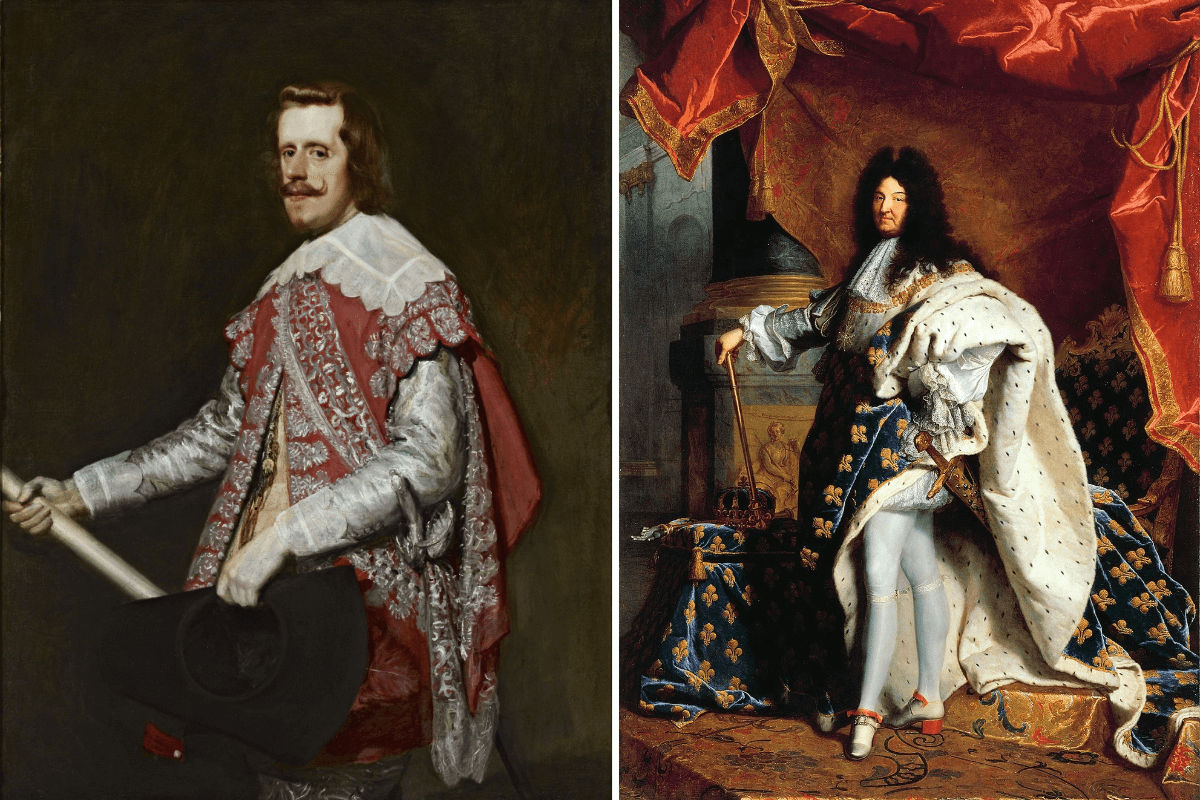
In the 17th century, official portraits give us an image of masculinity that is sumptuous and theatrical. Think of the portraits of Philip IV of Spain painted by Diego Velázquez, or those of Louis XIV depicted by Hyacinthe Rigaud: ivory silks, candy-colored velvets, embroidered tights, lace, and silk shoes with elaborate heels served as visual symbols of supremacy and divine right. Color and opulence became extensions of the sovereign’s body.
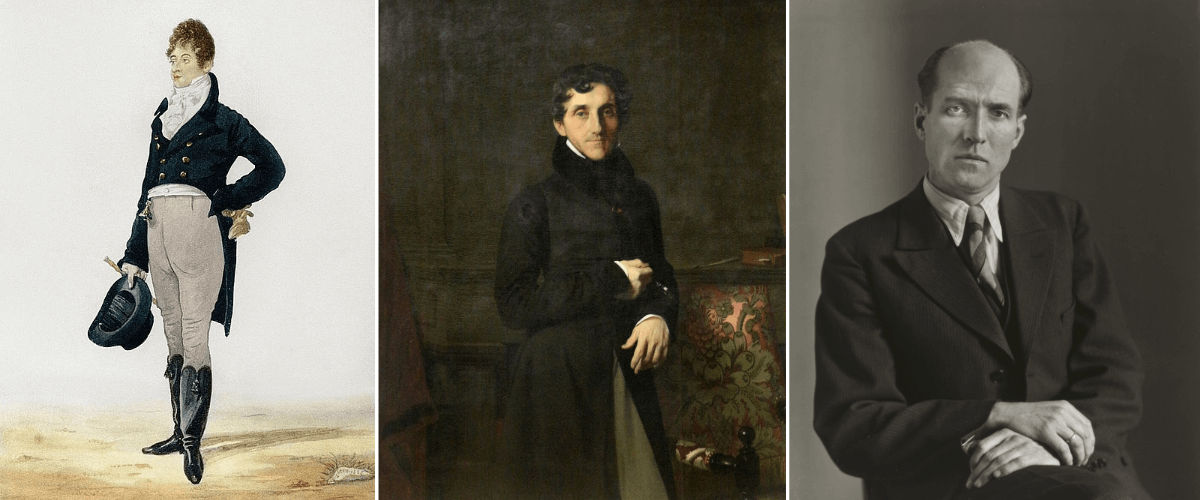
But with the rise of the bourgeoisie and the ascent of industrial capitalists, masculinity took on a new face: men adopted the dark suit as their new social armor. In the 19th century, John Flügel spoke of the “Great Male Renunciation”: the abandonment of ornament in favor of sobriety and rigor. From Beau Brummell, the icon of the dandy, to the portraits of Jean-Auguste-Dominique Ingres (Portrait of Count Molé, 1837) and the photographs of August Sander (The Businessman, 1920), the male figure cloaked himself in black, gray, or dark blue. Elegance became invisible; hidden detail was the only space left for personality.
The 20th century and contemporary times continue to move between these two poles: the sobriety of the suit as a symbol of authority, and the increasingly urgent pursuit of personal expression and inner freedom.
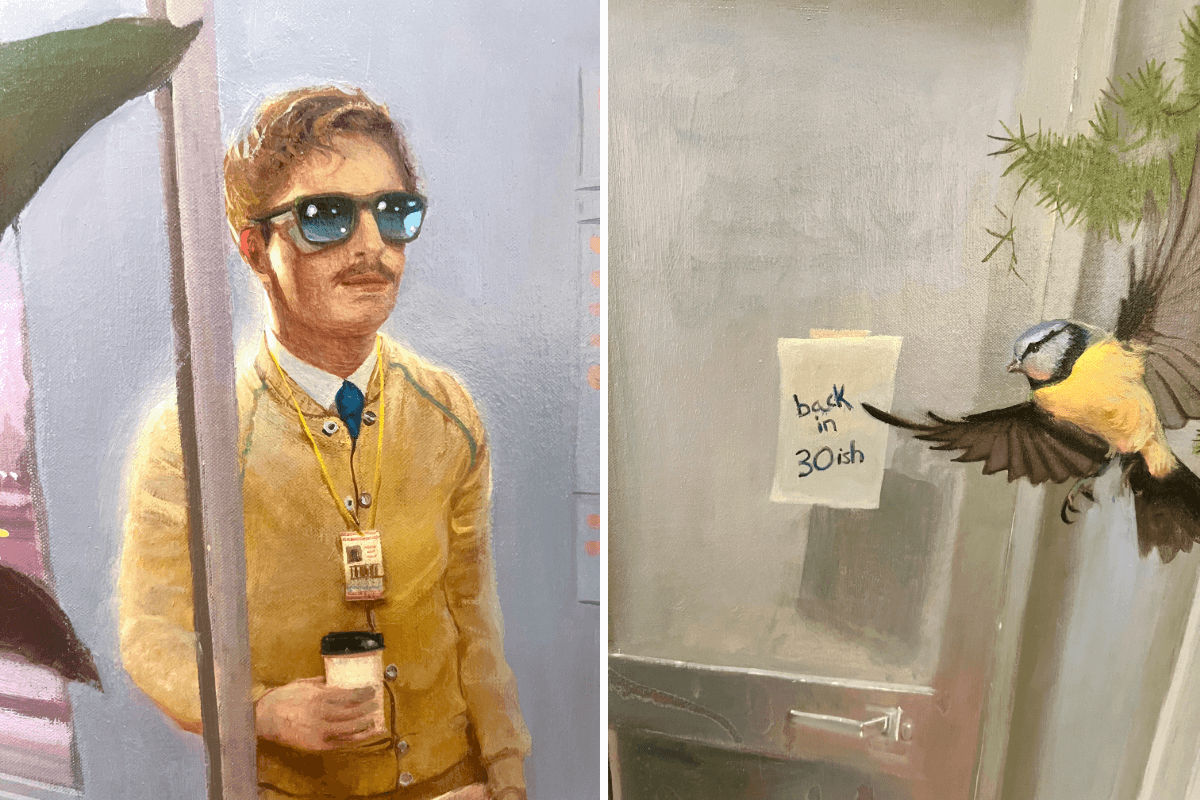
Jonathan Viner’s Essential Personnel: the man who dreams and reinvents himself.
With Essential Personnel (2024), Jonathan Viner gathers and transforms this long-standing iconographic narrative. The protagonist of his work is a man of the present day: an urban worker who bears the signs of modernity but reinterprets them with style and awareness. His warm, luminous sand-colored suit breaks the dominance of black—it is a garment that speaks of openness, of a rediscovered balance between life and work, between productivity and well-being.
The dark sunglasses, badge, sports bag, and takeaway coffee are details that construct a complex and authentic identity: that of a man who maintains his individuality even while immersed in the machinery of the city. But it is the colors and the composition that reveal the most poetic dimension: Viner’s man is surrounded by lush plants, by foliage that invades the workspace, and by birds in flight that seem to suggest lightness, freedom, and dream.
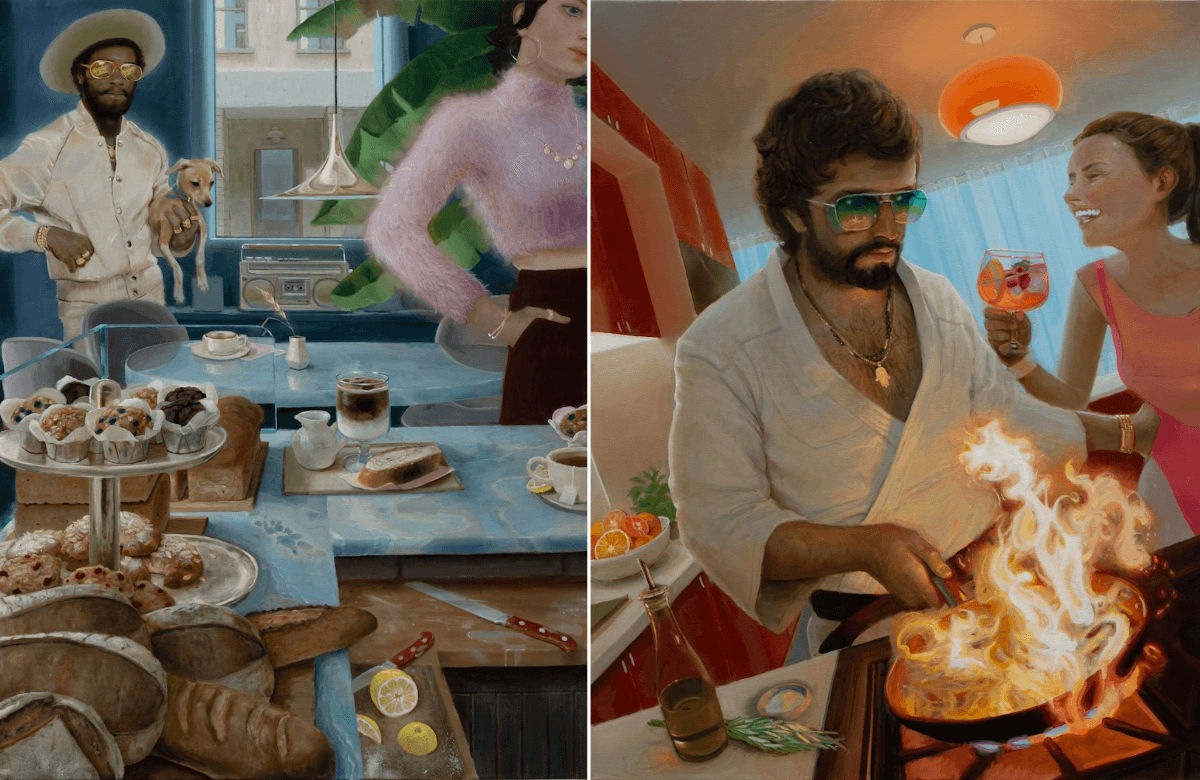
The floor glows with pink and orange tones; the reflections of sunset stream through the windows. The city is transformed into an inner landscape—a place where masculinity can finally embrace its more sensitive, creative, and imaginative side. In Essential Personnel, the man is no longer enslaved by the dark suit as armor of power, but becomes a bearer of a new elegance—one made of softness, harmony, and the courage to redefine himself.
Viner offers us a manifesto of contemporary masculinity: a man who dares to dream without abandoning practicality, who seeks a new balance between his productivity and an authentic desire for well-being and beauty.
Dior Summer 2025: a dialogue between art and fashion
This same vision of masculinity is echoed in the Dior Summer 2025 collection, where men’s tailoring opens up to color, lightness of lines, and an elegance that celebrates inner harmony and creative courage. Like Viner’s man, the Dior man rewrites his identity and style, choosing a masculinity that is freer, more sensitive, and poetic.
«The man who tries to be like everyone else loses himself in the infinite gray of the crowd; but the man who dares to be himself—even with a simple gesture, a small detail, an outfit—becomes more authentic than anyone else.»
— Oscar Wilde, The Picture of Dorian Gray (1890)
— Oscar Wilde, The Picture of Dorian Gray (1890)


