
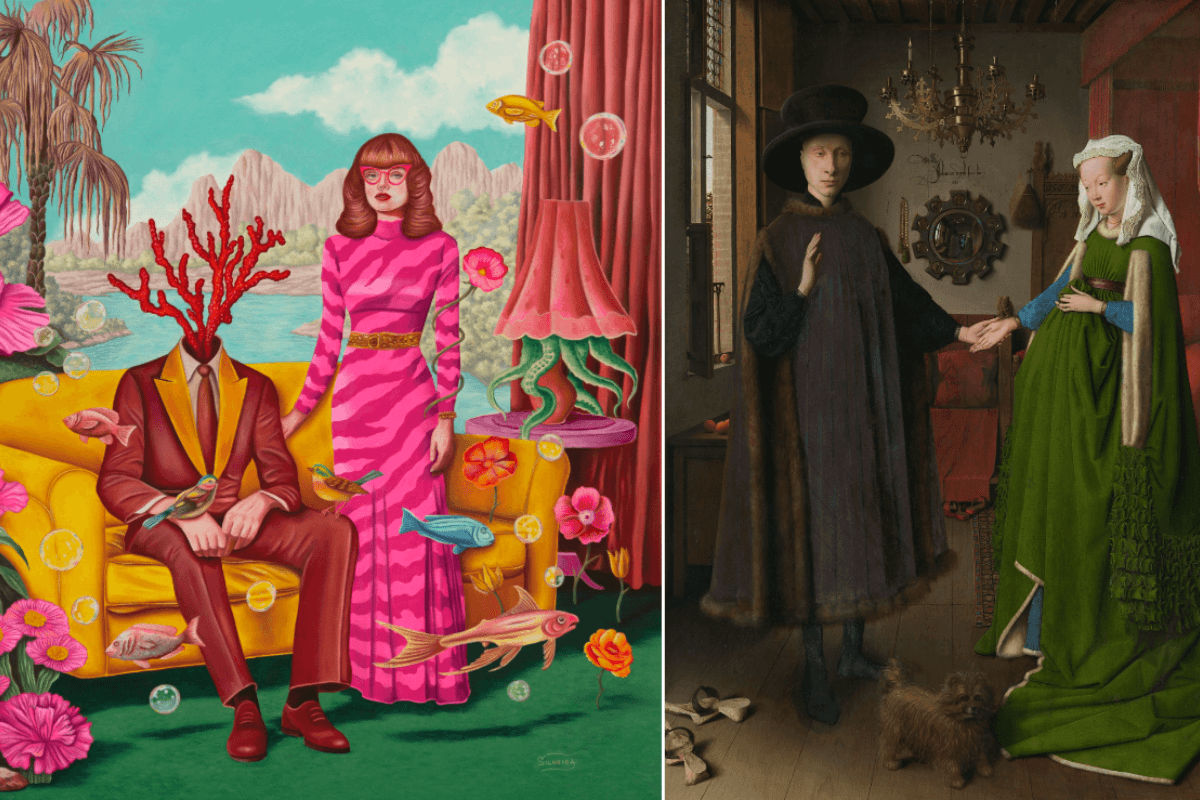
The hypnotic monocle of these two characters evokes the idea of a couple who, while maintaining their individuality and differences (he in a suit and tie, she in pearls and a red dress), merge into a single perceptual act. In Eyeconic Couple, Silveira suggests that perfect union lies not in the absence of identity, but in the ability to see the world together.
The surrounding botanical elements—tropical flowers and leaves—enhance this feeling: like a secret Eden, the couple becomes an archetype of natural harmony, at once familiar and mysterious. The finely carved frame, with the heart at its center, completes the metaphor: love as root, a bond carved into time and shared vision.
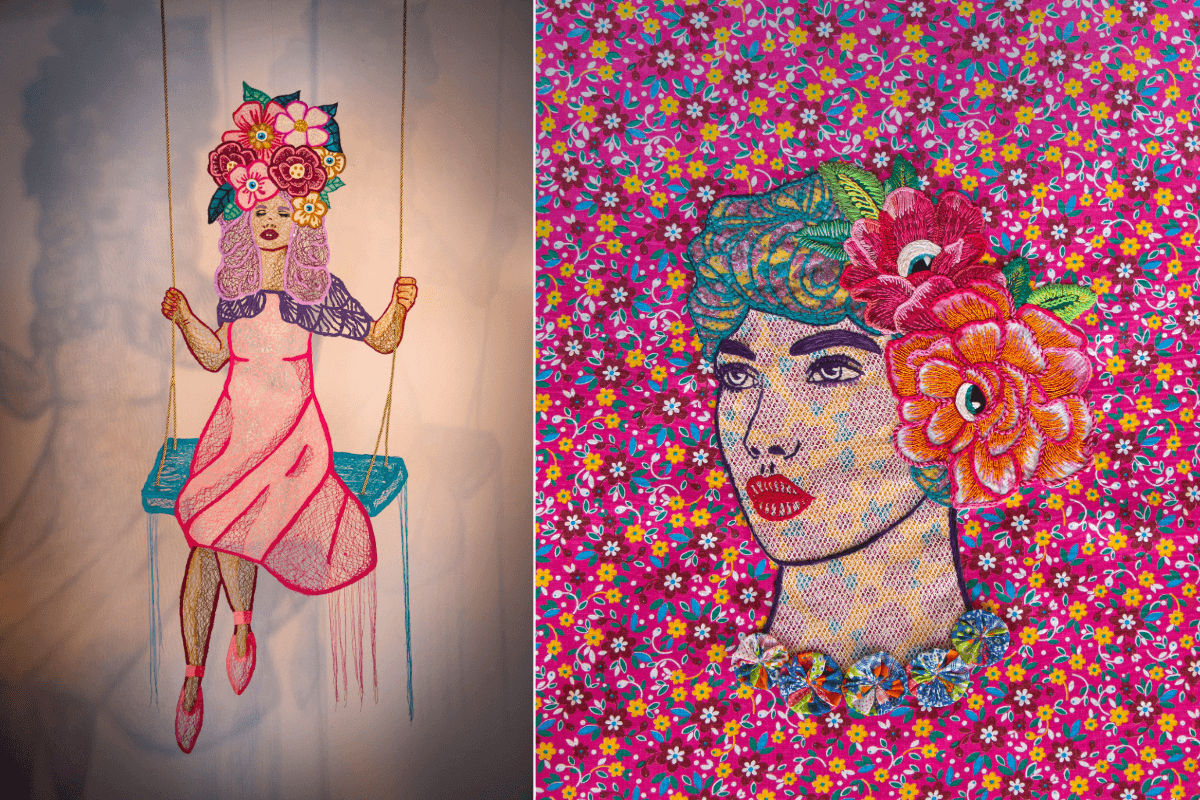
Iconic Couples: Stories of Connection and Creation
In a journey that weaves past and present, we encounter other couples who transformed their bond into artistic gesture, moving beyond individuality to create shared work.
Niki de Saint Phalle & Jean Tinguely
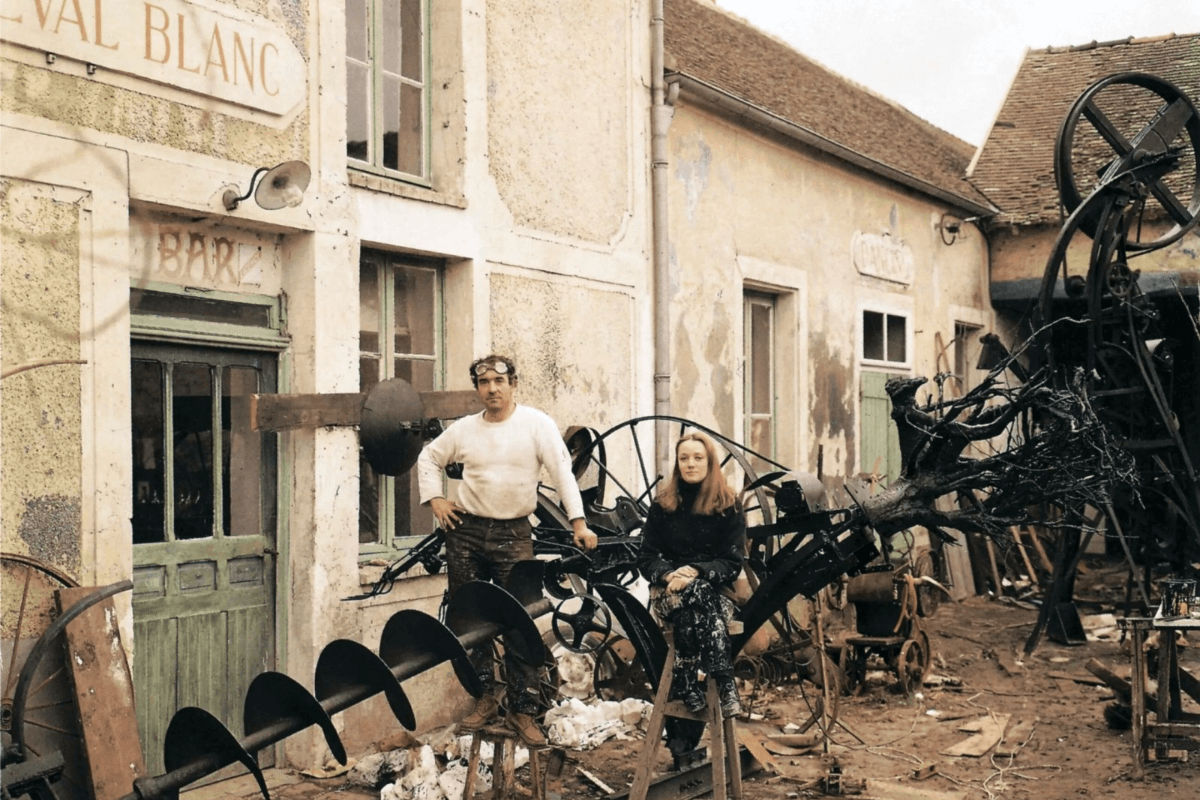
Niki and Jean met in 1955 and began a creative and romantic dialogue that would go on to transform public spaces and gardens around the world. She created her monumental Nanas—bursts of color and femininity—while he built fragile, poetic machines. Together, they gave life to works like the Stravinsky Fountain (1978), a symbol of love as play, dance, and urban wonder.
"Jean taught me that you can create while laughing." — Niki de Saint Phalle
Christo & Jeanne-Claude

Born on the same day (June 13, 1935), they seemed destined to meet. United in both conception and execution, Christo and Jeanne-Claude signed all of their land art projects together—from the wrapped coastline of Wrapped Coast (1969) to the poetic The Gates (2005) in Central Park. Theirs was a love of bold challenges and expansive freedom, like the landscapes they embraced.
"Our work is an urgency, just like our love." — Christo
Robert & Sonia Delaunay
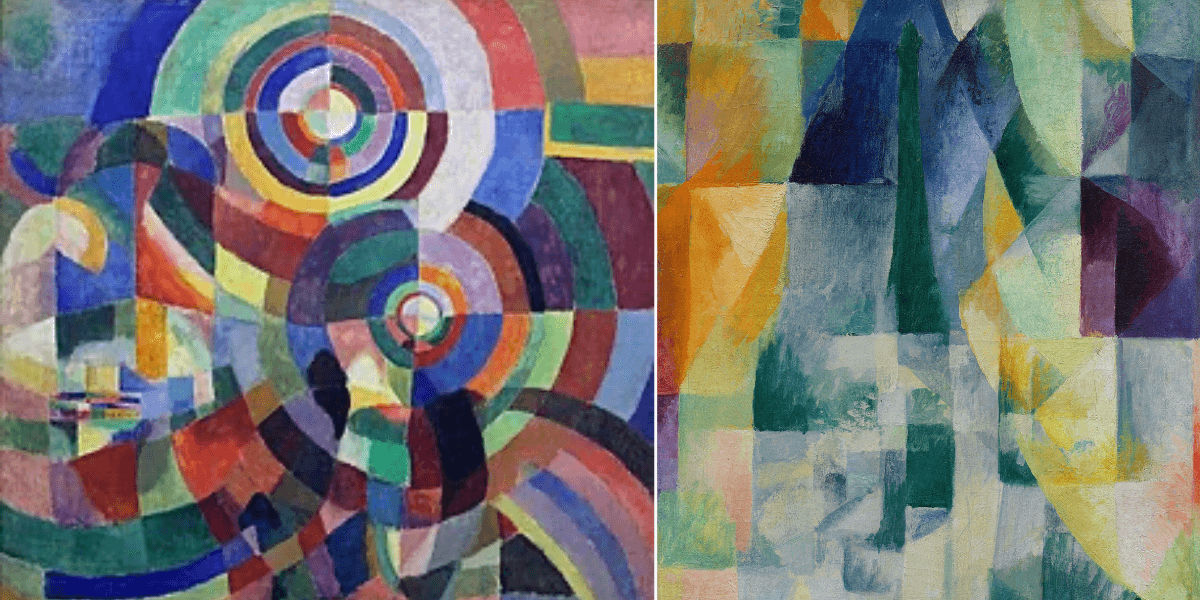
Robert and Sonia were the prophets of Orphism—an art of simultaneous light and chromatic vibration. Their Paris home was a shared laboratory, a vortex of ideas and color. Sonia once wrote: "Our paintings were conversations in two voices." Together, they turned visual language into a symphony of forms and sounds.
Charles & Ray Eames
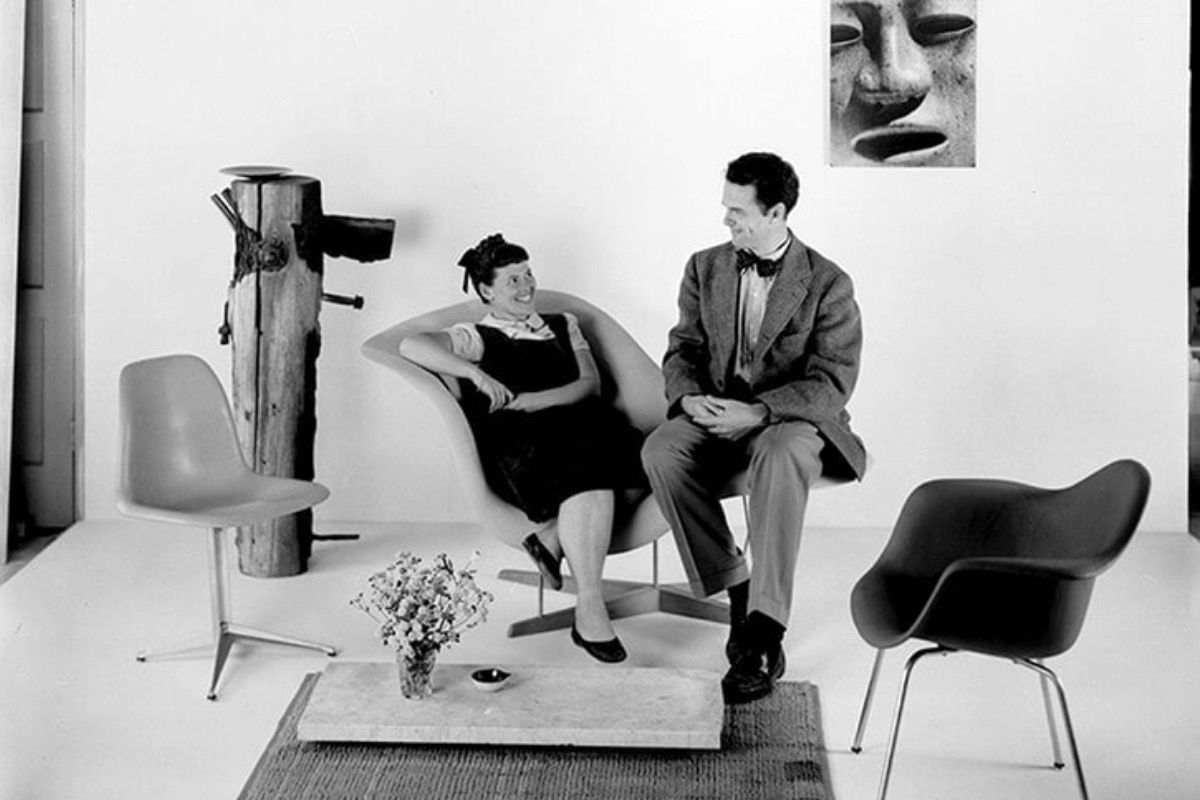
More than designers, they were creators of a new way of living and thinking about space. Charles and Ray Eames designed homes, furniture, films, and toys together, blending functionality with poetry. The Eames Lounge Chair (1956) became a symbol of comfort crafted with love. It’s said that Ray once remarked: "Whatever we did, it had to make us happy."
Gilbert & George
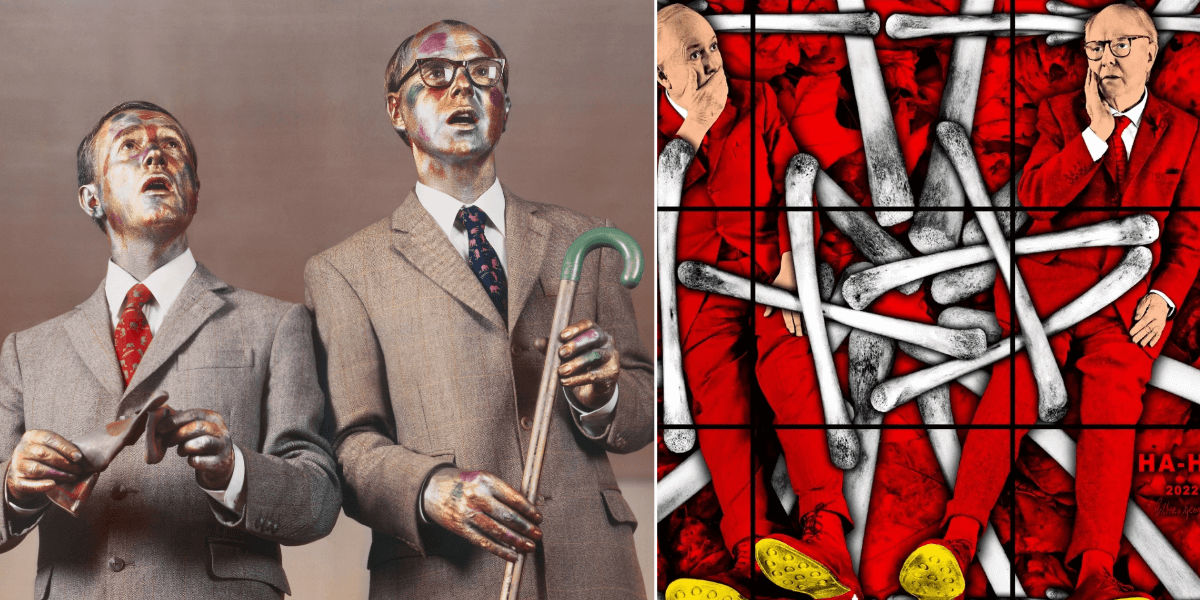
Since 1967, Gilbert & George have declared themselves “Living Sculptures,” rejecting any separation between art and life. Every work is born of their being a couple: every photo, drawing, and public act is jointly signed, as two inseparable halves of a single creative organism.
Bernd & Hilla Becher
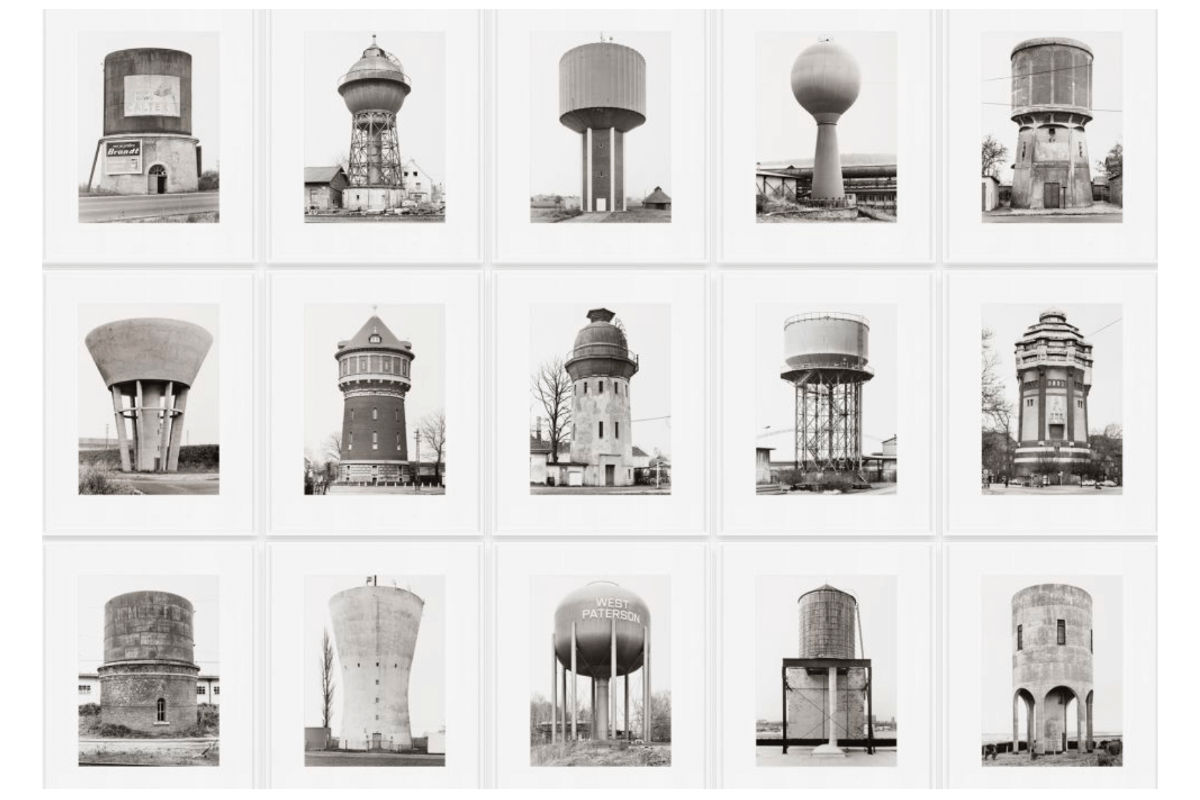
Together, they transformed industrial photography into visual poetry, documenting water towers, chimneys, and refineries with both precision and delicacy. Their art was a silent conversation between two perfectly attuned gazes—an ode to the memory of forms.


